No products in the cart.

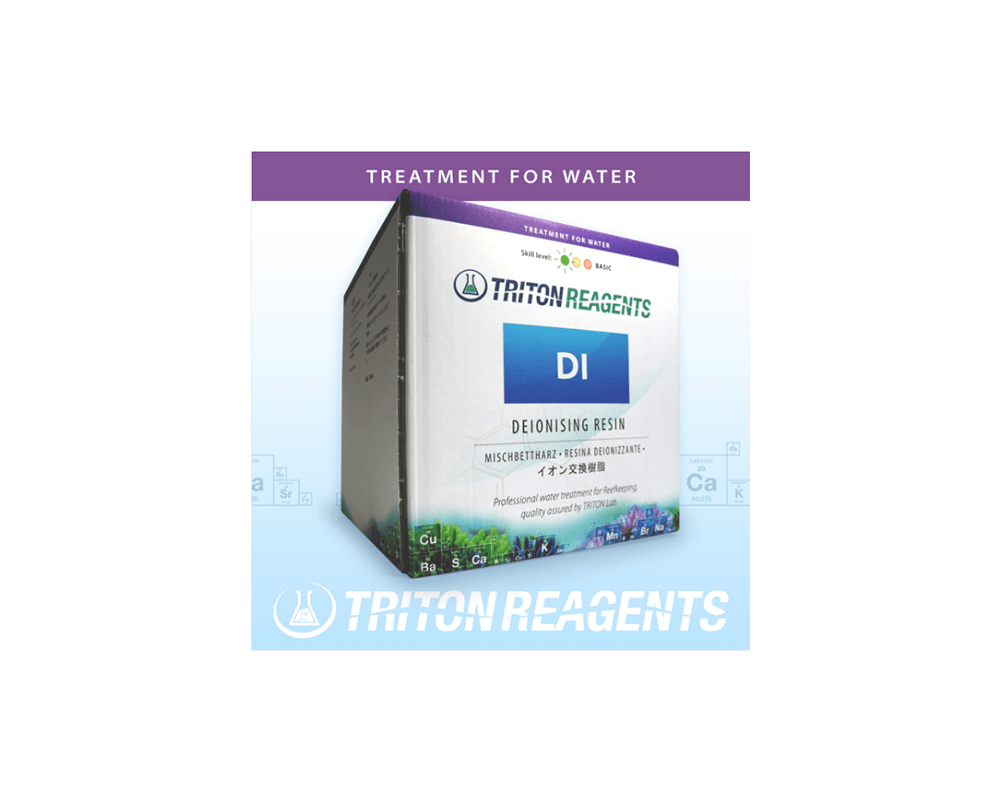




Triton Deionising (DI) Resin is a premium-grade, mixed-bed ion exchange resin designed specifically for the production of ultra-pure water for marine reef aquariums. In the pursuit of a successful reef, the quality of the source water is the foundation of all chemistry. Triton DI Resin is engineered to remove the final traces of dissolved solids (TDS) that survive the Reverse Osmosis (RO) process, including difficult-to-capture ions like silicates, nitrates, and phosphates. By ensuring a 000 TDS output, this resin prevents the introduction of unwanted contaminants that fuel algae outbreaks and interfere with the precision of the Triton Method.
This nuclear-grade resin provides the highest level of purification, ensuring your top-off and salt-mix water is chemically "blank."
Nuclear Grade Quality: Highly refined mixed-bed resin (cation and anion) that offers a higher exchange capacity and longer life than standard hobbyist resins.
Targeted Silicate Removal: Specifically effective at binding silicates and heavy metals that often "leak" through older RO membranes, preventing diatom blooms.
TDS 000 Guaranteed: When used as a final stage in a standard RO/DI system, it ensures the complete removal of all remaining ionized impurities.
Phosphate & Nitrate Free: Processed under strict laboratory conditions to ensure the media itself does not leach any nutrients into your purified water.
Universal Compatibility: The granular format is designed to fit all standard 10-inch clear DI canisters, refillable cartridges, and inline DI units.
| Feature | Specification |
| Resin Type | Mixed Bed (Cation/Anion) |
| Quality Grade | Nuclear / Laboratory Grade |
| Target Output | 000 TDS |
| Primary Targets | Silicates, Nitrates, Phosphates, Heavy Metals |
When should I replace my Triton DI Resin?
You should replace the resin as soon as your TDS meter reads 001 ppm. Once the resin is exhausted, it can "dump" captured ions (like silicates) back into your water in high concentrations.
Why should I use Triton Resin instead of standard DI resin?
Triton resin is a nuclear-grade media, meaning it has a higher ratio of anion and cation exchange sites. This results in a much higher capacity for removal and a longer lifespan before the resin becomes saturated.
Does the resin change color when exhausted?
While some resins use a color-changing dye as an indicator, Triton focuses on the purity of the media. We recommend relying on a calibrated TDS meter for the most accurate measurement of resin exhaustion.
How should I store unused resin?
Keep the resin in its original airtight bag in a cool, dark place. If the resin dries out, it loses its ion-exchange capacity and will no longer function effectively.
Triton ICP-OES Water Test: Use an ICP test on your RO/DI water to see if your current filtration is successfully removing difficult elements like Copper or Tin.
Triton Core7 Base Elements: Ensure the high-purity minerals in Core7 aren't being compromised by poor-quality top-off water.
https://petstore.ae/products/triton-base-elements-triton-method-5l?_pos=18&_sid=6617410d6&_ss=r
Triton AL99 Phosphate Remover: If your DI resin has failed and introduced silicates into your tank, AL99 is the best way to remove them from the water column.